Field Note
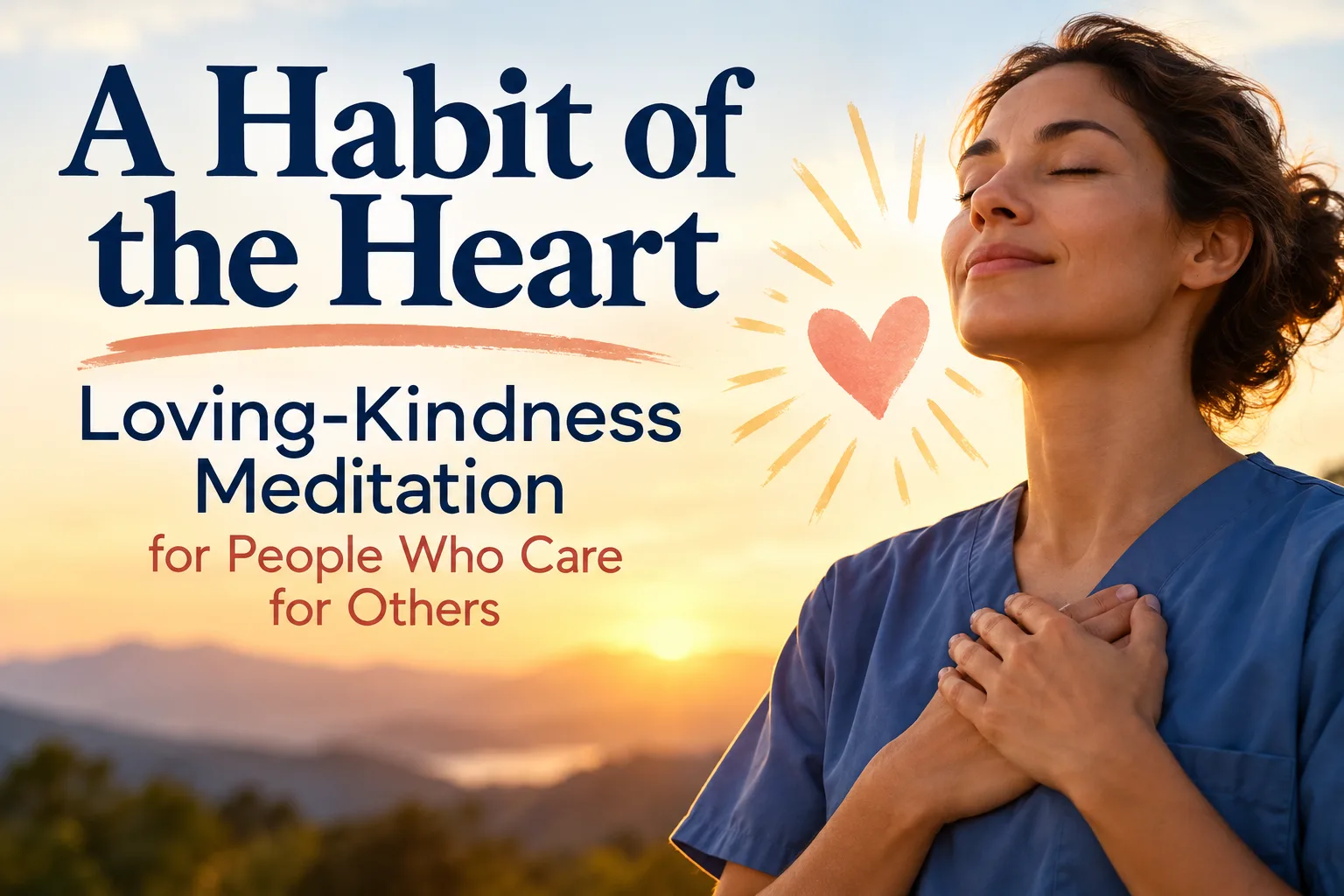
A Habit of the Heart: Loving-Kindness Meditation for People Who Care for Others
Loving-kindness meditation trains a steady intention of goodwill that can turn draining empathy into sustaining compassion. Early trials with nurses are promising, but practice strengthens people and only design repairs systems.
Listen to this article
AI-narrated audio. The text on this page is the authoritative version.
Most of the clinicians I know did not enter healthcare because they wanted a job. They entered because they wanted to help. Somewhere between the productivity targets, the documentation, and the steady exposure to other people's pain, many of them lose touch with that original wish. Loving-kindness meditation is, at its simplest, a way of practicing that wish on purpose.
I come to this practice as a physical therapist who has spent more than 35 years around suffering, my own and other people's, and as a researcher studying loving-kindness meditation as a response to occupational distress in rehabilitation therapists. What follows brings together the traditional practice and what the research now shows, and says plainly what this practice can and cannot do for people who care for others.
A word about language before going further. Most people call what I study burnout. I use a different name, Occupational Distress Syndrome, and I will use it, or simply occupational distress, throughout this post. Burnout suggests a personal failing, a candle that ran out of wax, as if the problem lives inside the person who is struggling. Occupational distress puts the emphasis where it belongs, on the conditions of the work: demands that outstrip resources, moral injury, effort that goes unrewarded, and workplaces where people do not feel safe to speak. The name matters because it shapes where we look for solutions.
Where the Practice Comes From
Loving-kindness is the English rendering of metta, a Pali word that carries the sense of friendliness or benevolence. Its classic source is the Karaniya Metta Sutta, a discourse preserved in the Pali Canon, in which the Buddha compares this quality to the boundless protectiveness a mother feels for her only child. Metta is one of the four brahmaviharas, the "divine abodes," alongside compassion (karuna), sympathetic joy (mudita), and equanimity (upekkha).
It is worth being precise about what metta is not. It is not romantic love, and it is not sentimentality. It is closer to goodwill: a steady, unconditional wish for the happiness and wellbeing of all beings, ourselves included. That steadiness is the point. A feeling comes and goes with circumstance. An intention can be returned to, again and again, regardless of how the day is going. That is why I describe loving-kindness as a habit of the heart rather than a mood.
How the Practice Works
The structure is simple. You settle into a posture that is relaxed and awake, take a few slow breaths, and bring to mind someone easy to love. Then you silently offer them a few sincere wishes. In my own practice the phrases are "May you be well. May you be happy. May you be healthy. May you be free from suffering and its causes." Other traditions and teachers use different words, wishes for safety, for ease, for peace, but they all carry the same sincere hope for another person's wellbeing.
From there the circle widens. You turn the same wishes toward yourself, then toward a neutral person, someone you see but do not really know. When you are ready, you include someone difficult. Finally you let the wishes extend to all beings everywhere, and then you let the words go and simply rest in whatever warmth or quiet remains.
The order matters. Classical instructions often begin with oneself, but Western teachers have repeatedly found that people struggle to direct kindness inward first. Thupten Jinpa built this insight into Compassion Cultivation Training at Stanford, which moves from a loved one to oneself (Jinpa, 2015). I follow the same sequence, beginning with a friend, a child, a grandparent, or a beloved animal, and I have watched it help. Starting with someone whose face makes you smile gives the heart something to lean on before it attempts the harder work of self-kindness. For clinicians, who are often far better at caring for others than for themselves, that gentler entry point is not a small thing.
The importance of that self-directed step really hit home for me when I worked with weight loss clients. I went in expecting to talk about exercise and habits. What I kept encountering instead was an astounding need for self-compassion training. Again and again, the hardest part of the work was not the plan itself but the way people spoke to themselves when the plan did not go perfectly. That experience changed how I think about this practice. Offering yourself the same goodwill you would offer someone you love is not a soft extra. For many people, it is the missing piece.
The words matter less than the sincerity behind them. If a phrase feels hollow, change it. I keep an expanded set of phrases on my guided loving-kindness page, along with a recording you can follow, but the best phrases are the ones you can actually mean.
Try the guided loving-kindness meditation
Why Empathy Is Not Enough
Tania Singer and Olga Klimecki draw a sharp distinction between empathy, which shares another person's pain and can turn into aversive, self-focused empathic distress, and compassion, a feeling of warmth and concern joined with the motivation to help (Singer & Klimecki, 2014). In a training study, compassion training increased positive affect even while participants watched others suffer, which the researchers described as a new coping strategy for facing the distress of others (Klimecki et al., 2013); I explore the distinction more fully in Compassion Is Not What You Think It Is.
This matters enormously for anyone whose work is caring. Clinicians do not develop occupational distress because they care too much. Many develop it because sustained exposure to suffering, without the conditions or the skills to transform empathy into compassion, slides into empathic distress. Loving-kindness and related practices train exactly that transformation.
Loving-Kindness and the People Who Care
The workplace evidence is still young but promising. A meta-analysis of loving-kindness and compassion meditation among employees found reductions in burnout (which this site calls occupational distress) and stress, along with gains in mindfulness, self-compassion, mental health, and interpersonal relationships (Wang et al., 2024). In two randomized trial reports with neonatal intensive care nurses in Tehran (66 nurses in each), one month of guided loving-kindness practice lowered scores on the Nursing Compassion Fatigue Inventory (Asadollah et al., 2023) and reduced burnout, which this site calls occupational distress, as measured by the Maslach Burnout Inventory (Asadollah et al., 2024). Larger trials are underway, including a randomized study at UCLA testing a program built on all four brahmaviharas for physicians with elevated stress (Korecki et al., 2026).
My own doctoral work focuses on rehabilitation therapists in skilled nursing facilities, a group that is understudied and, in my experience, chronically stretched. These are clinicians who spend their days helping people recover function and dignity, often under productivity demands that leave little room for either. If loving-kindness can help them hold the suffering they witness with more warmth and less depletion, that is worth knowing well.
A Practice, Not a Prescription
Here is the caveat I promised. Because Occupational Distress Syndrome grows from the conditions of the work, it is fundamentally a systems problem. No meditation fixes understaffing. No phrase repairs a broken schedule. When organizations offer mindfulness apps in place of reasonable workloads, they shift the burden of a system's design onto the individuals harmed by it.
So I hold two convictions at once. Loving-kindness is a genuinely useful practice for the people doing the caring, and it deserves a place in clinical education and professional life. And the organizations that employ those people remain responsible for building conditions in which compassion can survive. The practice strengthens the person. Only design strengthens the system. We need both.
Begin Where You Are
If you want to start, start small. Five or ten minutes a day is enough, and a short practice you actually do is worth more than a long one you keep postponing. Begin with someone easy to love. If you feel nothing, that is normal and not a sign of failure. You are setting an intention, not producing a feeling, and the warmth often shows up later, in an ordinary moment off the cushion, sometimes in the middle of a treatment session. If grief or old pain surfaces, return to the breath and be patient with yourself. Save the difficult person for later, and remember that wishing someone well does not excuse what they did. It loosens the grip resentment has on you.
You do not need to be Buddhist to practice. Wishing yourself and others well is a human capacity, practiced by people of every faith and of none. When you are ready, you can follow along with the recording on my loving-kindness page, and if you want to go deeper into the history and teaching, Kornfield's guide to loving-kindness meditation is a thoughtful place to continue (Kornfield, 2026).
May you be well. May you be happy. May you be free from suffering and its causes.
Care differently, not less.
References
Asadollah, F., Nikfarid, L., Nourian, M., & Hashemi, F. (2024). The impact of loving-kindness meditation on job-related burnout of nurses working in neonatal intensive care unit: A randomized clinical trial study. Holistic Nursing Practice, 38(5), 259-266. https://doi.org/10.1097/HNP.0000000000000657
Asadollah, F., Nikfarid, L., Sabery, M., Varzeshnejad, M., & Hashemi, F. (2023). The impact of loving-kindness meditation on compassion fatigue of nurses working in the neonatal intensive care unit: A randomized clinical trial study. Holistic Nursing Practice, 37(4), 215-222. https://doi.org/10.1097/HNP.0000000000000590
Jinpa, T. (2015). A fearless heart: How the courage to be compassionate can transform our lives. Hudson Street Press.
Klimecki, O. M., Leiberg, S., Lamm, C., & Singer, T. (2013). Functional neural plasticity and associated changes in positive affect after compassion training. Cerebral Cortex, 23(7), 1552-1561. https://doi.org/10.1093/cercor/bhs142
Korecki, J. R. T., Winston, D., Ko, E., Yoo, S., Khalili, J., & Bower, J. E. (2026). Protocol for project FIERCE: A randomized controlled trial to evaluate a positive emotion-focused meditation intervention for physicians with elevated stress. PLOS ONE, 21(9), Article e0357906. https://doi.org/10.1371/journal.pone.0357906
Kornfield, J. (2026, April 8). Lovingkindness meditation: A complete guide to the practice of metta. https://jackkornfield.com/loving-kindness-meditation-2/
Singer, T., & Klimecki, O. M. (2014). Empathy and compassion. Current Biology, 24(18), R875-R878. https://doi.org/10.1016/j.cub.2014.06.054
Wang, R., Gu, X., Zhang, Y., Luo, K., & Zeng, X. (2024). Loving-kindness and compassion meditations in the workplace: A meta-analysis and future prospects. Stress and Health, 40(1), Article e3273. https://doi.org/10.1002/smi.3273
Where this fits
Originally published at russlhommedieu.com on October 21, 2026.
Care differently, not less.